
Leadership & Organizational Transformation
You Are the Culture: How Individual Actions Shape Team Norms
By Kim Kewney
Founder & Executive Director · The Mindset Matrix Institute™
Originally published April 2025 · 6–8 minute read
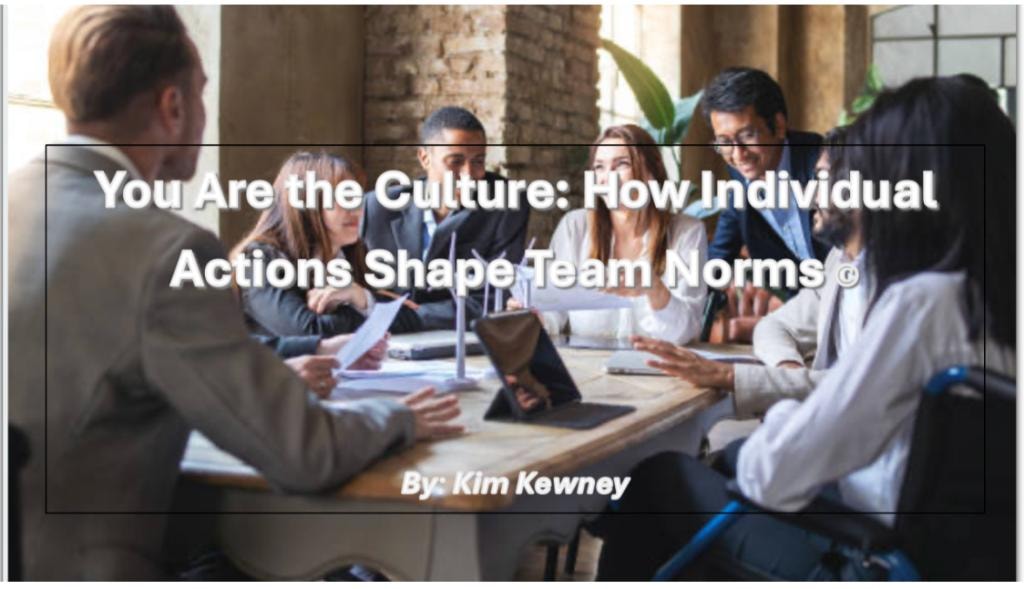
Publication Note: This article was originally published in April 2025reformatted for publication by The Mindset Matrix Institute™. The original content has not been substantively altered.
When we talk about organizational culture, we often think of mission statements, values posters on the wall, or company-wide initiatives. But the truth is far more personal — and far more powerful. Culture isn't created by initiatives alone. It is shaped every day through the behaviors, decisions, and conversations of the people within an organization.
Every person in a team — from the newest hire to the most senior leader — is actively contributing to the culture, whether they realize it or not. The question isn't whether you're shaping culture. The question is: what kind of culture are you shaping?
Foundational Leadership Philosophy
Culture isn't created by initiatives alone — it is shaped every day through the behaviors, decisions, and conversations of the people within an organization.
This is not a leadership abstraction. It is a daily reality — and a daily responsibility.
Culture Starts with Individuals — Not Initiatives
Research consistently shows that culture is not something that happens to organizations — it is something that people within organizations create. According to Gallup's State of the Global Workplace report, only 23% of employees worldwide are engaged at work, and much of that disengagement is tied not to pay or benefits, but to how people are treated day-to-day by their managers and peers.
Amy Edmondson's research on psychological safety reinforces this: teams perform better not because of their talent alone, but because of the interpersonal environment they create together. That environment is built — or eroded — through individual actions, one interaction at a time.
Research Insight
"Teams perform better not because of their talent alone, but because of the interpersonal environment they create together."
Amy Edmondson — Psychological Safety Research
This means that culture change doesn't require a new initiative or a consultant. It requires individuals — at every level — to become more intentional about the signals they send through their everyday behavior.
What You Normalize, You Reinforce
Charles Duhigg, in The Power of Habit, describes how habits — including social habits — become self-reinforcing loops. What gets repeated becomes expected. What gets expected becomes normal. And what becomes normal becomes culture.
In a team setting, this means that the behaviors you allow, model, or ignore become the unwritten rules of how your team operates. If a leader consistently interrupts people in meetings, that behavior signals that interrupting is acceptable. If a team member regularly takes credit for shared work, that behavior signals that individual recognition matters more than collective contribution.
Conversely, when a leader pauses to acknowledge a team member's contribution, or when a colleague speaks up to include a quieter voice in a discussion, those actions also become norms — norms that build trust, belonging, and engagement.
Negative Signals That Can Erode Culture
It's worth naming the behaviors that quietly damage culture — not because people are malicious, but because they often go unexamined:
Dismissing ideas without engagement
When contributions are brushed aside — especially in front of others — people learn to stop offering them.
Modeling overwork as a virtue
When leaders celebrate exhaustion or constant availability, they signal that rest and boundaries are weaknesses.
Avoiding difficult conversations
When problems are left unaddressed, teams learn that honesty is risky and that issues are better left unspoken.
Inconsistent accountability
When some people are held to standards and others are not, fairness erodes — and with it, trust.
Passive disengagement
Showing up physically but not mentally — scrolling during meetings, giving minimal responses — signals that the work and the people don't matter.
None of these behaviors require intent to cause harm. But their cumulative effect on culture is real — and measurable.
Positive Signals That Strengthen Culture
The same logic applies in the other direction. Small, consistent positive behaviors accumulate into a culture of trust, respect, and high performance:
- Saying "I don't know — let me find out" models intellectual humility and psychological safety.
- Giving credit publicly and specifically reinforces that contributions are seen and valued.
- Checking in on a colleague who seems overwhelmed signals that people matter more than output.
- Naming a problem directly — and early — builds a culture where honesty is safer than silence.
- Following through on small commitments builds the trust that makes large commitments possible.
Brené Brown's research on vulnerability and belonging reminds us that these moments of connection — however brief — are not peripheral to the work. They are the work. They are what make sustained performance possible.
Leadership Insight
"These moments of connection — however brief — are not peripheral to the work. They are the work."
Brené Brown — Research on Vulnerability and Belonging
Practical Strategies for Leaders and Individuals
If culture is built through individual actions, then culture change is available to everyone — not just those with formal authority. Here are five strategies that any leader or team member can begin practicing immediately:
Lead by Example, Not Just Policy
Policies set the floor. Behavior sets the ceiling. If you want a culture of respect, model respect — especially when it's inconvenient. If you want a culture of accountability, hold yourself accountable first.
Set and Re-Set Norms Together
Don't assume your team shares the same unwritten rules. Name them explicitly. Have conversations about how you want to work together — and revisit those agreements when the team changes or when norms drift.
Address Small Moments Early
Culture is made in the small moments — the comment that went unchallenged, the meeting that started without the quieter voices. Addressing these moments early, with curiosity rather than judgment, prevents them from calcifying into norms.
Make Recognition Part of the Routine
Recognition doesn't require a formal program. It requires attention. Notice what people are doing well — and say so. Specifically. Regularly. In front of others when appropriate.
Leaders: Turn Feedback Into Dialogue
Feedback given as a monologue creates compliance. Feedback given as a dialogue creates growth. Ask questions. Listen. Be willing to be changed by what you hear.
When Everyone Owns the Culture, It Changes
One of the most common mistakes organizations make is treating culture as a leadership problem — something that senior leaders create and employees receive. But culture is not a top-down broadcast. It is a collective, ongoing negotiation between every person in the organization.
When individuals at every level begin to see themselves as culture-makers — not just culture-receivers — something shifts. People start to ask different questions: not "why is the culture like this?" but "what am I contributing to the culture today?"
That shift in ownership is where real culture change begins. Not in a strategy document. Not in a values workshop. In the next conversation you have, the next decision you make, the next moment you choose to speak up — or to listen more carefully.
Reflection
What am I contributing to the culture today?
This is the question that transforms passive participants into active culture-makers. It is available to every person in every organization, every single day.
Final Thought
You are not a passive observer of your organization's culture. You are one of its authors. Every day, through the choices you make about how to show up, how to treat people, and what you're willing to tolerate or challenge, you are writing a line in the story of what your team is becoming.
The culture you want — one of trust, accountability, belonging, and high performance — is not waiting to be handed down from above. It is waiting to be built, one intentional action at a time, by you.
References
- Brown, B. (2018). Dare to Lead: Brave Work. Tough Conversations. Whole Hearts. Random House.
- Duhigg, C. (2012). The Power of Habit: Why We Do What We Do in Life and Business. Random House.
- Edmondson, A. C. (2018). The Fearless Organization: Creating Psychological Safety in the Workplace for Learning, Innovation, and Growth. Wiley.
- Gallup. (2023). State of the Global Workplace: 2023 Report. Gallup Press.
© 2025 Kim Kewney / The Mindset Matrix Institute™. All rights reserved. Originally published April 14, 2025. This article may not be reproduced, distributed, or transmitted in any form without prior written permission.
About the Author

Kim Kewney
Founder & Executive Director · The Mindset Matrix Institute™
Kim Kewney is the Founder of The Mindset Matrix Institute™, where she works with individuals, families, leaders, educators, and organizations to create meaningful, lasting change through an evidence-informed approach to human development. Her work integrates neuroscience, leadership, emotional intelligence, and organizational transformation into one cohesive framework.
Meet The Founder →Continue Exploring
More from The Knowledge Library
Explore additional publications from The Mindset Matrix Institute™.
← Return to Knowledge Library