
Neuroscience & Human Behavior
Inclusive Communication: Adapting to Neurodiverse and Non-Neurodiverse Operational Styles
By Kim Kewney
Founder & Executive Director · The Mindset Matrix Institute™
Originally published April 2025 · 6–8 minute read
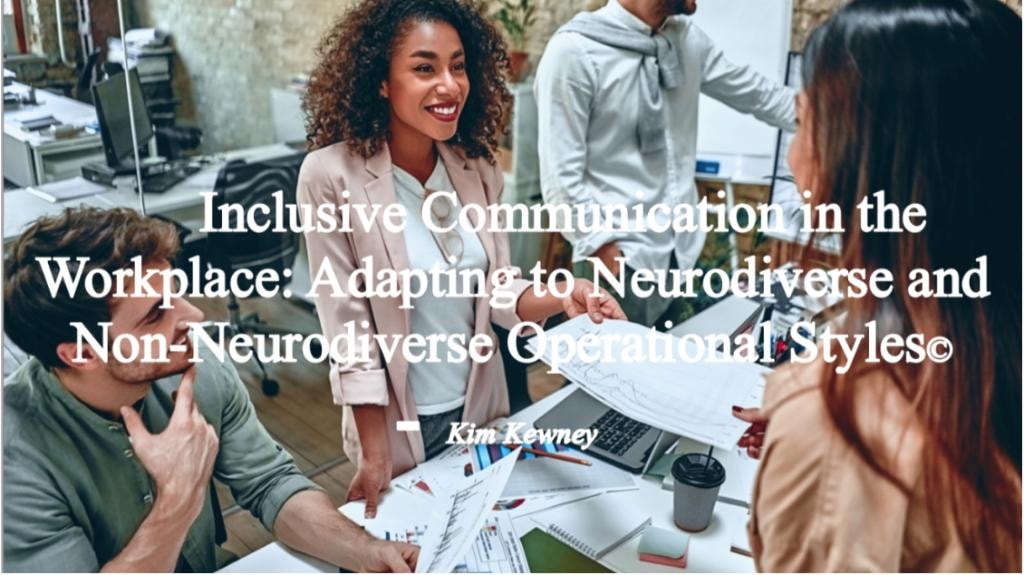
Publication Note: This article was originally published in April 2025reformatted for publication by The Mindset Matrix Institute™. The original content has not been substantively altered.
In today's diverse workplace, effective communication is more than just exchanging information — it's about understanding and adapting to the unique ways in which individuals process and share information. This is particularly important when working with neurodiverse individuals, whose brains function differently from what is considered "typical." Neurodiversity encompasses a range of conditions, including autism, ADHD, dyslexia, and others, each bringing unique strengths and challenges to the workplace.
Research has shown that neurodiverse teams can be highly innovative and productive. A Harvard Business Review article by Austin and Pisano (2017) found that companies like SAP, Hewlett Packard Enterprise, and Microsoft have intentionally sought to hire neurodiverse individuals because they bring exceptional skills in pattern recognition, memory, and mathematics. However, to harness these benefits, organizations must foster an environment of inclusive communication.
This article explores strategies for adapting communication styles to meet the needs of both neurodiverse and non-neurodiverse employees, fostering a more inclusive and productive workplace.
Core Communication Principle
Start with curiosity, not assumption.
The most powerful shift a leader or colleague can make is to approach every interaction with genuine curiosity about how another person thinks, works, and communicates — rather than defaulting to assumptions about what "normal" looks like.
Start With Curiosity, Not Assumption
The first step in inclusive communication is to approach interactions with curiosity rather than assumptions. This means taking the time to understand each individual's unique communication style, strengths, and challenges. Rather than assuming that everyone communicates in the same way, leaders and colleagues should ask open-ended questions to learn more about how each person prefers to work and communicate.
For example, instead of assuming that a neurodiverse employee struggles with social interactions, a manager might ask, "How do you prefer to receive feedback?" or "What communication methods work best for you?" This approach not only helps to identify potential barriers to communication but also demonstrates respect and a genuine interest in the individual's needs.
Reflective Workplace Questions
These questions, asked with genuine curiosity, open the door to more effective and inclusive working relationships:
- "How do you like to work?"
- "What helps you do your best work?"
- "What part of this project feels unclear to you?"
- "What do you need from me to succeed here?"
Research by Doyle (2020) supports this approach, finding that when employees feel understood and valued, they are more likely to be engaged and productive. By starting with curiosity, leaders can create a foundation of trust and open communication that benefits all employees, regardless of their neurological profile.
Build on Strengths, Don't Just "Fix" Weaknesses
Inclusive communication also involves recognizing and building on the unique strengths that neurodiverse individuals bring to the workplace. Rather than focusing solely on "fixing" perceived weaknesses or deficits, leaders should identify and leverage the exceptional skills and talents that neurodiverse employees often possess.
For instance, many individuals with autism have exceptional attention to detail and pattern recognition skills, which can be invaluable in roles that require precision and analytical thinking. Similarly, people with ADHD often excel in creative thinking and problem-solving, particularly in fast-paced environments that require quick decision-making.
Research Insight
"Companies like SAP, Hewlett Packard Enterprise, and Microsoft have intentionally sought to hire neurodiverse individuals because they bring exceptional skills in pattern recognition, memory, and mathematics."
Austin & Pisano, Harvard Business Review (2017)
By adopting a strengths-based approach to communication and task assignment, leaders can help neurodiverse employees to thrive and contribute their best work. This might involve providing clear, structured tasks that align with an individual's strengths, or offering opportunities for neurodiverse employees to share their expertise and insights with the broader team.
Armstrong (2010) argues that neurodiversity should be viewed as a natural and valuable form of human diversity, rather than a set of disorders to be treated or managed. By embracing this perspective, organizations can create a culture that values and celebrates the unique contributions of all employees, fostering a more inclusive and innovative workplace.
Promote Collaborative Accountability
Inclusive communication requires a shared commitment to accountability and continuous improvement. This means creating a culture where all employees, regardless of their neurological profile, feel empowered to speak up, share their ideas, and take ownership of their work.
One effective strategy for promoting collaborative accountability is to establish clear, transparent communication norms and expectations. This might involve creating explicit guidelines for meetings, such as providing agendas in advance, allowing for different modes of participation (e.g., verbal, written, or visual), and ensuring that all voices are heard and valued.
Provide Agendas in Advance
Share meeting agendas ahead of time so all participants can prepare, process, and contribute meaningfully — regardless of how they work best.
Allow Multiple Modes of Participation
Create space for verbal, written, and visual contributions. Not everyone communicates most effectively in real-time verbal discussion.
Ensure All Voices Are Heard
Actively invite quieter team members to contribute. Structured turn-taking or written input channels can surface ideas that might otherwise go unshared.
Make Expectations Explicit
Clearly articulate what is expected, by when, and in what format. Ambiguity creates unnecessary friction for neurodiverse and non-neurodiverse employees alike.
Additionally, leaders can promote collaborative accountability by encouraging regular check-ins and feedback sessions, where employees can share their experiences, challenges, and successes. This not only helps to identify and address potential communication barriers but also fosters a sense of community and shared purpose within the team.
Research by Edmondson (1999) on psychological safety in teams found that when employees feel safe to take interpersonal risks, such as speaking up or admitting mistakes, they are more likely to engage in the kind of open, honest communication that drives innovation and continuous improvement. By fostering a culture of psychological safety and collaborative accountability, leaders can create the conditions for inclusive communication to thrive.
Leadership Insight
"When employees feel safe to take interpersonal risks — speaking up, admitting mistakes, asking questions — they engage in the kind of open, honest communication that drives innovation and continuous improvement."
Edmondson (1999) — Psychological Safety in Teams
Lead by Example
Perhaps the most powerful strategy for promoting inclusive communication is for leaders to model the behaviors and attitudes they wish to see in their teams. This means demonstrating curiosity, empathy, and a genuine commitment to understanding and adapting to the diverse communication needs of all employees.
Leaders can lead by example by openly discussing their own communication preferences and challenges, and by actively seeking feedback on how they can better support the needs of their team members. This not only helps to normalize conversations about communication styles and neurodiversity but also demonstrates a commitment to continuous learning and improvement.
Furthermore, leaders can promote inclusive communication by advocating for the resources and support that neurodiverse employees need to succeed. This might involve working with HR to develop inclusive hiring practices, providing access to assistive technologies or accommodations, or creating opportunities for professional development and mentoring.
Practical Communication Actions for Leaders
- Openly discuss your own communication preferences and invite others to do the same.
- Actively seek feedback on how you can better support the communication needs of your team.
- Advocate for assistive technologies, accommodations, and inclusive hiring practices.
- Create mentoring and professional development opportunities that are accessible to all.
- Normalize conversations about neurodiversity — make it a regular part of team culture, not a one-time training.
Research by Catalyst (2020) found that inclusive leadership behaviors, such as empathy, humility, and a commitment to fairness, are strongly associated with higher levels of team innovation, engagement, and performance. By leading with these qualities, managers can create a culture of inclusive communication that benefits all employees and drives organizational success.
Conclusion
Inclusive communication is not just a nice-to-have — it's a business imperative. By adapting communication styles to meet the needs of both neurodiverse and non-neurodiverse employees, organizations can unlock the full potential of their diverse workforce, driving innovation, engagement, and performance.
The strategies outlined in this article — starting with curiosity, building on strengths, promoting collaborative accountability, and leading by example — provide a practical framework for creating a more inclusive and effective communication culture in the workplace.
As our understanding of neurodiversity continues to evolve, it is essential that organizations remain committed to learning, adapting, and growing in their approach to inclusive communication. By doing so, they can create workplaces where all employees, regardless of their neurological profile, feel valued, understood, and empowered to contribute their best work.
References
- Armstrong, T. (2010). Neurodiversity: Discovering the Extraordinary Gifts of Autism, ADHD, Dyslexia, and Other Brain Differences. Da Capo Press.
- Austin, R. D., & Pisano, G. P. (2017). Neurodiversity as a competitive advantage. Harvard Business Review, 95(3), 96–103.
- Catalyst. (2020). Inclusive Leadership: The View from Six Countries. Catalyst.
- Doyle, N. (2020). Neurodiversity at work: A biopsychosocial model and the impact on working adults. British Medical Bulletin, 135(1), 108–125.
- Edmondson, A. (1999). Psychological safety and learning behavior in work teams. Administrative Science Quarterly, 44(2), 350–383.
© 2025 Kim Kewney / The Mindset Matrix Institute™. All rights reserved. Originally published April 14, 2025. This article may not be reproduced, distributed, or transmitted in any form without prior written permission.
About the Author

Kim Kewney
Founder & Executive Director · The Mindset Matrix Institute™
Kim Kewney is the Founder of The Mindset Matrix Institute™, where she works with individuals, families, leaders, educators, and organizations to create meaningful, lasting change through an evidence-informed approach to human development. Her work integrates neuroscience, leadership, emotional intelligence, and organizational transformation into one cohesive framework.
Meet The Founder →Continue Exploring
More from The Knowledge Library
Explore additional publications from The Mindset Matrix Institute™.
← Return to Knowledge Library